Category: Uncategorized


Return2Play launches new service for touring teams – “Doctor on Tour”

By Harry Black,

16 April 2018

Return2Play is excited to announce the launch of a new service which will ensure players receive the highest possible standards of care, even when touring abroad.

The service – named “Doctor on Tour” – came about following discussions with partner schools who were seeking ways to enhance the medical support they have while touring.

Dr Sam Barke, Medical Director of Return2Play, commented:

We are delighted to be able to expand our services and further commit to helping organisations provide the highest level of care to their players. Feedback from our partner schools is that managing injury or illness while on tour is one of the issues that causes staff the most worry. It is our hope that this service provides both staff and parents with the peace of mind that players will be well looked after, wherever they are in the world.– “S.Barke”

Initially, two levels of support will be offered. The first – “Remote Support” – will provide a 24/7 line to UK doctors for immediate medical advice and webcam assessments of injury or illness. The second – “On Tour Support” – will enable touring sides to take a doctor on tour with them.

For further details on the new service please visit www.doctor-on-tour.co.uk

To introduce the service, Return2Play is offering discounts for tours taking place between June and August 2018. To request a quote, please contact hello@doctor-on-tour.co.uk or fill in the form on the website.

  Category: Slider item, Uncategorized
  Comments: Comments Off on Return2Play launches new service for touring teams – “Doctor on Tour”

Return2Play to be the Official Medical Partner of the Rosslyn Park 2018 HSBC National Schools Sevens

By Harry Black,

Retun2Play are pleased to be the Official Medical Partner to the world’s largest school rugby event, the Rosslyn Park 2018 HSBC National Sevens. The tournament takes place from Monday 19th March until Friday 23rd March.

Commenting on the partnership Dr Sam Barke, Medical Director of Return2Play, said:

We are delighted to once again be partnering with Rosslyn Park National Schools 7s as Official Medical Partner. We look forward to being part of the tournament, seeing some great rugby and working with the organisers to ensure that all players receive the highest level of medical care if injured.– “S.Barke”

Return2Play is the leading sports medicine provider to schools. We believe players of all ages and ability should have access to the best medical care without delay. Our innovative technology ensures players are supported from the day of injury until they are fit, able and confident to return to sport. Return2Play’s technology, alongside our consulting, education and immediate care services gives schools the peace of mind that they are providing their players with gold-standard care at all times.

For more information about this event please click here for the RPNS7 website.

  Category: Slider item, Uncategorized
  Comments: Comments Off on Return2Play to be the Official Medical Partner of the Rosslyn Park 2018 HSBC National Schools Sevens

Medical Director’s Blog – Concussion: Teachers have an important role to play

By Harry Black,

Updated January 2020

By Dr Sam Barke

in 2018, Scotland Sport released new guidance on the management of concussion (click here) – an update that can be applauded for a number of reasons.  Firstly, the fact that a country has produced guidelines that are applicable to all sports – something that I have previously discussed the relevance of (see Concussion: It’s Not a Rugby Injury).  And secondly, because there is a far stronger focus on returning to “normal activity” – which for children includes returning to the classroom – before returning to sport.


Involvement of academic staff
This is something we at Return2Play have been talking about for a while.  We advise our partner schools to engage all staff in education, not just the sports department, and to make sure teachers are informed when one of their pupils sustains a concussion.  Part of this is because there are clearly benefits of everyone having increased awareness – concussions don’t only occur on the sports field –  but also because teachers have an important role to play in recovery.


Children struggling through
When our doctors see children in clinic who are still suffering symptoms a few weeks after a concussion the story is often the same.  They had concussion but symptoms weren’t too bad so they went to school the next day.  They didn’t feel great but struggled through.  The next day the same again but slightly worse and so on and so on.  Often these are low severity symptoms, but significant ones -particularly in terms of impact on learning – such as headaches, difficulty concentrating, a “fogginess”.  Kids aren’t good at flagging these symptoms – sometimes they haven’t even realised they are linked to the concussion – so teachers (as well as parents, of course) have a hugely important role to play in recognising the issues early.  The earlier it is recognised; the earlier interventions can be put in place; the better the outcome will be.


Graduated Return to Learn
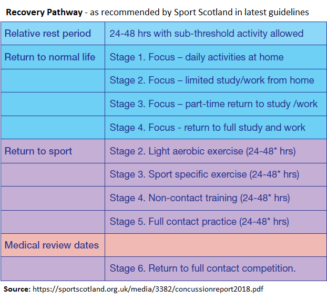
It seems obvious really.  On your route to returning to sport, the first step is returning to normal life.  We happily prescribe a gradual return to sport so why would we not prescribe a gradual return to learning?  It is this that Sport Scotland have tried to do in their guidelines (see below).  It may not be perfect, and it may not suit every child, but the principle is certainly right and it’s an excellent start.


Change in mindset
We’ve come a long way in a relatively short period of time when it comes to our understanding of concussion, our acknowledgment of the risks, and our implementation of guidelines.  This has been led by the sporting world and, understandably, the initial focus was “how can we safely get people back to sport?”.  In the majority of settings this is now being done well and so it is right that a slight refocus should happen so that we look more closely at how we maximise people’s recovery away from sport.


We now accept that, after a concussion, missing a few weeks of sport is in the long-term interest of the player. But the same theory should be applied to the classroom. Missing a few days of school to allow optimum recovery and a quick return to full academic ability is in the interest of all.


To read the other blogs in the concussion series, please follow the links below.

Concussion: Back to Basics

Concussion: There’s no recovery fast track

Concussion: It’s not a rugby injury


  Category: Slider item, Uncategorized
  Comments: Comments Off on Medical Director’s Blog – Concussion: Teachers have an important role to play

Peter Scott – Life in Hockey

By Harry Black,

We spoke with Peter Scott, a young and talented England International Hockey player who made his international debut in March 2017 against Germany. Having played hockey since he was 5 years old, Peter now represents Team Bath Buccaneers, Bath University and is contracted to England. With all of this and a degree to juggle, Peter has a very unique view on the amount of support provided from grassroots to elite international levels.


Congratulations on reaching the national indoors final with Team Bath Buccaneers. Losing such a narrow final to 12 times champions East Grinstead must have been difficult but was a great achievement to push them so close. What do you need to do next year to lift the trophy?

Yes it was an incredible achievement for us, it was the first time in the club’s history that we have even made the finals weekend so to make it to the final was pretty special. We were certainly the underdogs going into the finals but I think we more than proved ourselves to be a quality indoor team able to compete with any of the top teams. Regarding next season, the team just needs to maintain the solid structure that made other teams struggle against us this year while adding slightly more quality with our finishing going forward and well put ourselves in a solid position to challenge for the top spots again.


Where does reaching the final rank amongst your sporting achievements?

It is definitely up there as one of my highlights so far. The atmosphere in the Copper Box made it a great event to be a part of and celebrating winning our semi-final on shuffles was a great feeling.

Sport provides so many opportunities and chances to learn not just the sports themselves but also vital transferable skills that can be used in everyday life– “Peter”


What was the highlight of your school sporting career?

I think the highlight of my school sporting career was playing in the Sainsbury School Games in 2014. It was good to have a taste of what an event like that is like and I feel like I learned a lot from that tournament that I have taken forward into future tournaments.


When you were at school who did you look up to the most, who inspired you?

Barry Middleton was always someone who I looked up to. His work ethic was always something that was talked about by other coaches and watching him perform so consistently at international level was always something to aspire to. Harry Martin is also someone who inspired me whilst I was at school. His selection for the Olympic Games at such an early age was something that inspired me to focus on hockey and work hard to be in the position I am in now.


Did you face many challenges juggling international hockey whilst doing a degree?

Yes it has been quite tough to get the right balance between hockey and university over the past couple of years, although I have been lucky to have quite a lot of help from both the university and GB hockey who understand the commitments I do have and quite often provide alternative options for me.


Why do you think sport is important for young people?

Sport provides so many opportunities and chances to learn not just the sports themselves but also vital transferrable skills that can be used in everyday life. Things like team work and communication are two things I have significantly improved over the past few years and they have given me more confidence in not just my sporting life but my social life as well. Especially for young people who are constantly learning, I think sport provides a great platform to grow these skills.


Have you ever been out of play due to injury, and if so how did you find the experience of being injured?

Fortunately I have not.


Have you noticed many differences from the management of injuries at club hockey level to international level?

Yes, the management of players is significantly stricter at international level. With the support staff around the GB group, any injury is managed straight away with physios and doctors always on hand if needed at training sessions and competitions. When a player is injured they are in the gym every day rehabbing and doing what they can to get back to fitness before a steady inclusion back into the hockey sessions (depending on the injury).


Concussion is a huge talking point at the moment, and many are being put off playing high risk concussion sports. Do you think the awareness of the injury is high enough in Hockey?

I think the awareness of injury, especially serious injuries such as concussion is high in hockey. For example, short corners (arguably the most dangerous aspect of hockey) have been analysed significantly and therefore the protection worn by the players during these instances has increased over the past few years. I also think that the awareness of injury from general play has increased over the past few years and the ‘protection of the players’ is often something that is talked about when decisions are made on the pitch by the umpires.


Are you surprised to learn that Return2Play’s data shows Hockey to be one of top three highest risk sports for concussions?

I am not surprised about this due to the nature of the game but I don’t think it is something you can easily escape, especially in open play, as the sport is just so unpredictable, particularly at lower levels of the game.


Finally, if you could tell your younger self anything what would it be?

Make sure to keep working hard ‘behind the scenes’, that’s where the marginal gains are made that can have a massive impact on where you will be in the future.

Parent of a sporty kid: On the side-line

By Harry Black,

By Lucile De Carbonnieres
R2P Head of Operations


I am a mother of three young children, juggling a busy (read hectic!) home life with a charming (read hopeless!) husband, 5 delightful (read messy and demanding!) pets and a job for which I feel very passionate (read passionate …my boss will likely read this too!).


So, with all the above, where are you most likely to find me early on a freezing Sunday morning?  Reading the papers in bed with a nice cup of coffee with above mentioned “charming” husband? On the sofa, catching up on some TV box sets while cuddling with above mentioned “delightful” pets? On the side-line of a sport’s pitch, with frost bites to my toes and fingers while pretending to cheer on my precious offspring? The brood with endless energy wins hands down I am afraid! I am indeed one of those parents pacing on the side-lines wondering when the last blow of the whistle will rescue me from the cold.

Sport cannot be made totally risk free just like climbing a tree, running around in a playground or riding a bike cannot be made completely accident free.– “Lucile”

Our family weekends are filled with tennis, athletics, cross country running, hockey and rugby. Despite sounding like I am writing a new book, every Sunday morning, entitled Diary of a Whingeing Mum, I do love my children’s energy and boundless passion for the sports they have chosen. Sport will undoubtedly shape them to be healthier, more resilient, more courageous, more ambitious, more dignified in failure, good team players with strong values and appreciation of other people. What is there not to like? Injuries maybe.


It is a fact that with sport comes the risk of injuries and as a mother I never like to have to dry my children’s tears. We have had over the years a broken arm, a broken wrist, two broken toes, fractured teeth, and numerous bruises and cuts; thankfully not all for the same child! But interestingly, only one of these more serious injuries happened while playing “organised” sport, i.e. in school or clubs. The more serious injuries happened on the beach, falling off a bike or playing with friends.

Sport Injuries for children can be minimized through training and education– “Lucile”

There has been a lot written about the perceived dangers for children of some contact sports like rugby and hockey, but my experience as a mother is that these sports are taught by experienced and specially trained coaches who will never knowingly allow a child to continue to play while injured or recklessly expose a child to an unreasonable risk of sports injury.


All sports, whether individual, team or contact, carry a risk of injury. Sport cannot be made totally risk free just like climbing a tree, running around in a playground or riding a bike cannot be made completely accident free. Children cannot and should not live in a protective bubble. However, my hardwired instinct is to want to nurture and protect my children from harm so I want to see risks minimized wherever and whenever possible.


Sport Injuries for children can be minimized through training and education of sport parents, coaches (in clubs and schools) and administrators. This is where my passion for my work at Return2Play comes in. I am very proud to help make my children’s sports safer and allow them to enjoy their chosen passions.

Other Blogs you may be interested in

Parent of a sporty kid: Why You need to know concussion signs and symptoms

Tour de France Special: Cycling and Concussion

First Published 31/01/2018

Medical Director’s Blog – Concussion: It’s not a rugby injury

By Harry Black,

Updated January 2020

By Dr Sam Barke

A new year is here, and with it’s arrival we find ourselves moving into the final months of the rugby season.  School fixture lists will now be dominated by hockey and it won’t be long until we start to see the outfields being mown for the start of cricket.  I can almost hear the sigh of relief from some of the staff I have regular contact with as the anticipated reduction in numbers on the “off games” list soon starts to show.  But is rugby’s reputation fair?


Rugby has led the way

Outside of America, where American Football has been the main driver for advancing the knowledge on concussions, the rugby community has been at the forefront of research, education and implementing change in the way we deal with concussions.  World Rugby and the national bodies below it, such as the RFU, have led the way in raising awareness of the injury and advising on how it should be managed.  It is right that they have – rugby clearly carries a risk of concussion – but by being so they have also inadvertently taken ownership of the injury and dominated the headlines to the point where it would be easy to think it is only rugby which has a problem. I expect there are sports which are quite happy for rugby to take the negative press!


But does concussion happen in other sports?

Of course.  Concussion happens outside of sport – tripping in the playground, walking into a door, falling out of bed – so it makes sense that there is a risk of it happening in sport too.  All “major” sports governing bodies in England – RFU, ECB, RFL, FA, England Hockey –  have adopted concussion management guidelines, acknowledging that there is a risk of sustaining the injury playing their sport. Last summer, Steve Smith’s high profile concussion while playing cricket for Australia in The Ashes led to the first use of a concussion substitution in international cricket (see my article in The Times here – The Ashes: Steve Smith likely to feel concussion symptoms for at least a week).  A big step in acknowledging the importance of the dealing with the injury appropriately and raising awareness among the community and school game.


What does the Return2Play data show?

In 2019, our doctors undertook over 1000 “concussion assessments”.  Of these, 70% were sustained playing rugby (both training and matches).  After rugby, the second most common cause of injury were concussions sustained outside of sport (12%) in joint third place were football and hockey (5% each). The rest of were made up of injuries in sports as diverse as swimming, netball, cycling, skiing and basketball (plus 8 more).  It is, of course, worth noting that the majority of our clients are large rugby playing schools and rugby clubs so we would expect the numbers to be skewed towards that sport


“But surely rugby has a far higher risk than other sports?”

This is where it gets tricky. My usual answer is “how can we know?”.  Being able to collect data on the number of concussions occurring in sports relies on all of those sports understanding the injury and being able to recognise it. There is no doubt that understanding is high in the rugby community – with thanks to the RFU’s Headcase campaign but can the same be said across other sports?  On Saturday I was chatting to a hockey coach who had only seen a handful of concussions over their career. They were shocked to learn that you didn’t have to be knocked out to have sustained a concussion and suddenly appreciated they’d seen far more than they’d realised.


As ever, education is key

We need to move away from thinking of concussions as rugby’s problem.  Stop putting in place policy that requires only rugby players and rugby coaches to undertake concussion education.  At schools all staff and all pupils – whether involved in sport or not – should be aware of the injury and how it should be managed.  Only then will we be able to start making a fair comparison between sports.

To read the other blogs in the concussion series, please follow the links below.

Concussion: Back to Basics

Concussion: There’s no recovery fast track

Concussion: Teachers have an important role to play 

  Category: Slider item, Uncategorized
  Comments: Comments Off on Medical Director’s Blog – Concussion: It’s not a rugby injury

Medical Director’s Blog – Concussion: There’s no recovery “fast-track”

By Harry Black,

Updated January 2020

By Dr Sam Barke

As you’d imagine, Return2Play’s doctors see quite a few concussions. In fact, a quick check tells me that in 2019 we undertook over 1000 “concussion assessments”. A benefit of seeing so many in a relatively short period of time is that you start to see trends – not trends in how the injuries are occurring, that’s a blog post in itself – but trends in the common misunderstandings around recovery from concussion and the areas that most often need explaining to players.


1. “I don’t think I really had a concussion”

The standard opening sentence of the player desperate to get back to play. Not uncommonly it has been suggested by a friend or family member that everyone is being “over-cautious”. Or, even more difficult to deal with, a doctor with out-of-date knowledge has given the wrong advice.

I get the player to talk me through what happened. How did they feel immediately after the impact? How did they feel over the next few minutes? The next hour? Into that evening? And what about the following days? I explain the difficulties of concussion and talk about what we look at to try and diagnose it (see: Concussion: Back to Basics) and then the risks of getting it wrong. 99 times out of 100 the player sees how they fit the criteria and accept that they need to be treated as if they have had a concussion.


2. “I feel fine now, why can’t I play?”

If you broke your arm you’d be put in a cast. Pain, the main symptom of the injury, would settle within a week or so. At that point you wouldn’t rip off the cast and demand to play (at least, I hope you wouldn’t!), because you know that the bone is still healing and playing would risk further and probably more serious injury.

Concussion is no different. The symptoms may have settled but we know that this doesn’t necessarily mean the brain has recovered. Just like your broken arm, there are risks associated with getting further injuries when healing hasn’t fully taken place and it is those risks we are trying to avoid.


Knowledge Recap

What are the risks of getting a second injury?

During recovery the brain is more vulnerable to further injury. Repeat concussions during this time can result in:

  • Prolonged concussion symptoms
  • Possible increased risk of developing long term health problems eg mild cognitive impairment or degenerative brain disorders in later life
  • Second impact syndrome – sudden brain swelling causing death (extremely rare)

While it is difficult to quantify the likelihood of these occurring, I think we can all accept they are risks well worth avoiding. A few extra days rest, or a couple of missed games, isn’t much to ask.


3. “What difference does a couple of days make?”

For children the earliest possible return to sport after a concussion is 23 days. The majority of injuries happen at the weekend so sustaining a concussion usually means a minimum of three weekends off sport. It is often the case that day 23 falls on the Monday or Tuesday and players, understandably, question whether they can play in the day or two before then.

I’m honest with players. The chances are that if they went and played they would be absolutely fine. But, what if they’re not? What if they do take a knock and something nasty happens? People will start to ask “should he have been playing at all?”. I’m asked to justify why, as a doctor, I didn’t follow the guidelines. Your teachers and coaches are accused of putting you in harm’s way. Is it worth it? No, of course it’s not.
The player is still frustrated – I’d be surprised if they weren’t – but they understand the reasoning.


Educating players

In my experience, once the reasoning behind the guidelines has been explained to players, they understand why we enforce them – which is ultimately, of course, to protect them.
It’s worth you taking the time to explain the injury and the guidelines early. Get the player’s (and parents’) buy-in to the process – it’s likely to significantly improve compliance and will hopefully make your job of monitoring your players’ return far easier.

  Category: Slider item, Uncategorized
  Comments: Comments Off on Medical Director’s Blog – Concussion: There’s no recovery “fast-track”

Sam Jones – Dealing with Injuries

By Harry Black,

Return2Play spoke with Wasps Rugby star Sam Jones. Having suffered an injury last season and still awaiting his return to the pitch, we spoke to Sam about his experience with injury throughout his career.

Sam, firstly congratulations to Wasps Rugby for last season and getting to the Premiership final, it must seem a long time coming for you. How did it feel watching the game?
It was a bit bittersweet! It was a fantastic occasion for the entire club – both players and staff – although it was pretty gutting not to be out there or to have at least played a slightly bigger part in helping the club reach the final. As a spectator, the game was completely nerve wracking, it could have gone either way and although the result wasn’t what we wanted the boys gave it everything.


What do you think Wasps needs to do in order to get their hands on the trophy this season?
I think we just need to keep doing what we’ve been doing all year. As I said, it was so close that on another day we would have sneaked it. I think the experience of having been in a final will help us a lot over the next couple of seasons – as I think it helped Exeter having been beaten in the same match the year before. To become a successful team you need to learn from a few failures along the way.

“You have to look on the positive side otherwise it becomes very difficult”


Talking of trophies and achievements, what has been the highlight of your school sporting career?
In my final year at school, the 1st XV had an unbeaten season and made Rugby World’s School team of the month. Along the way we also beat out local rivals RGS High Wycombe 29-3 which was a huge achievement for us.


When you were at school who did you look up to the most, who inspired you?
I looked up to some of the older boys who went on to play professionally for Wasps having been picked from their schoolboy performances. Guys like Bob Baker and Jack Wallace showed if you worked hard and played well it wouldn’t go unnoticed by the top clubs.


Last season must have been tough for you, having just been called up to the England squad and what could have been your first premiership final, mental strength must play a huge part during an injury or concussion, do you have any tips for people coping with this?
You have to look on the positive side otherwise it becomes very difficult. Personally, I used the injury as a way to improve my strength and conditioning in the gym and get my body in better shape to perform for when I come back. It’s also a great opportunity to give the rest of your body a break from the regular battering it takes. Its also important to find something else to preoccupy you whether that be work in the community, some studying or work experience to keep you mentally stimulated and prepare you for life after rugby.


What do you find is the hardest part about being injured?
Not feeling a part of the team. Everything revolves around teamwork and when you are unable to contribute it becomes difficult. It’s important that you try and stay involved whether that’s socially or by helping out with coaching tips/analysis etc.


Has being injured given you more time to explore other interests, potentially things that you would like to do when you retire from rugby?
Yes, I’ve always been into restaurants and food so I would like to go into that industry after rugby. I’ve managed to do some writing for a couple of websites on the dining trends and certain new restaurant reviews and managed to make some valuable contacts for life after rugby.


Can you talk us through a typical daily routine since you have been injured?
I’ve spent most of my time in the gym! We start pretty early at about 8am with upper body weights followed by physio treatment and pretty intense rehab which lasts until lunch. After lunch we do a fitness/conditioning session followed by extra top ups such as static skills, prehab, core work. Once you get back to the stage where you can run you are slowly integrated back into full training.


From transitioning into professional rugby what differences have you noticed in how injuries and concussions are managed?
Everything is scrutinised a lot more. You have regular interactions with physios and doctors and they are constantly assessing your progress. They usually put in as much time as needed to get you back to where you need to be to perform at your best, whereas at school if you managed to see a physio/doctor it would be very limited. They also give you ongoing programmes to prevent injury rather than just reacting to acute ones.


Between school, club and academies do you feel that you played too much sport and if so, did this contribute to any injuries?
I was lucky growing up that I didn’t sustain too many injuries despite playing a lot of rugby. I only started picking up a few knocks when I moved to men’s rugby at the age of 17 as the physicality of the game became much more intense.


“Concussions are inevitable in a contact sport like rugby, but it’s how you manage them that’s important.”


If you suffered an injury during school years, what was the process of communicating this?
You would normally have to self diagnose your injury and inform the coaches of your various teams that you wouldn’t be able to play. It wasn’t ideal really as there just wasn’t the qualified medical staff to help. I was lucky that I was involved in the Wasps Academy as I could visit their physios and be treated much like a professional would.


Concussion is a huge talking point at the moment, and many are being put off playing sports like rugby, having suffered head injuries yourself, what is your opinion on the matter going forward?
Concussions are inevitable in a contact sport like rugby, but it’s how you manage them that’s important. The profile of head injuries has risen hugely which means that clubs and coaches are forced to treat them seriously which is great for player welfare. There just needs to be more information out there as it’s quite a grey area and I think we are getting there.


Who has been your most influential coach?
Rob Smith was my Academy Manager growing up and he guided my career in the early years which was an extremely important time.


Finally, if you could tell your younger self anything what would it be?
Try and relax a bit more! You play your best rugby when you’re enjoying it so just aim to do just that.
Thank you for your time and we all wish you and Wasps Rugby well for this season.


Sam’s thoughts on Return2Play

Having heard what Return2Play offer, and going on your own experiences, do you feel that R2P is something that will help grassroots sports become safer and managed better?

Certainly. It is allowing schoolboy and grassroots rugby access to a platform that is similar to what professional outfits use. Player welfare and safety is the most important thing in sport and R2P are making sure that everyone involved is up to speed with any one injury.


Did you ever struggle getting a doctor’s appointment at school, and did this ever prolong the time that you were unable to play for?

I’m not sure I ever went to a doctor – it seemed like too much hassle! This is certainly not advisable and with a platform like R2P it makes it much easier to find a certified professional who can give you permission to return to sport safely and quickly.
Return2Play nominated for the 2017 Sports Technology Awards

By james,

Following on from our nomination in the 2016 awards, we are very pleased to reveal that we have been nominated for the 2017 Sports Technology Awards as a finalist in the ‘Best Website Development’ category!

The Sports Technology Awards were founded in 2014 with a view to celebrating and rewarding innovation in sport. A panel of industry experts received hundreds of entries from across a range of sports from every continent and so we are very proud to have been nominated alongside some famous names such as Channel 4, Samsung, NBA and BT Sport. This year’s judges include The Baroness Grey-Thompson, England football manager Gareth Southgate and Dame Katherine Grainger to name but a few!

For more information about who we are up against on May 4th, please see the STA website.

  Category: Slider item, Uncategorized
  Comments: Comments Off on Return2Play nominated for the 2017 Sports Technology Awards